
On Research-Creation “inside” and “outside” of academia: thinking about our metaphors – Part I
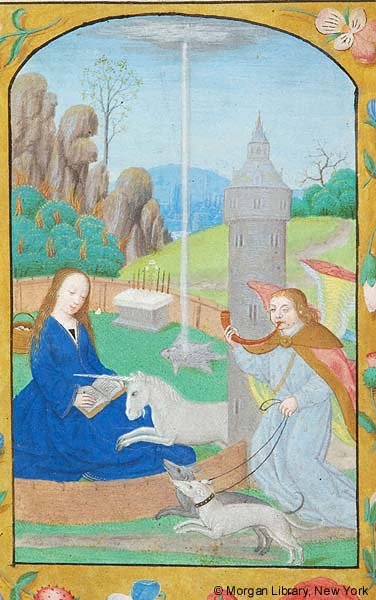
An hortus conclusus, or “enclosed garden,” depicting an ivory tower. Annunciation, ca. 1500, The Morgan Library & Museum, MS G.5 fol. 18v. Available at https://ica.themorgan.org/manuscript/page/5/76803.
All artists and creative practitioners conduct some form of inquiry during their process. Some experiment with tools (by learning how to play an instrument, weave on a loom, or operate a camera), and by learning and experimenting with these skills, one can deepen their practice; others make art tied to their personal or family histories, historical processes, technological innovation, or about anything, really.
Within the university, what we call “research-creation”—where reflective creative practice is itself the process by which we answer our research questions—is often followed by institutional expectations that go beyond it. These are about ethics approvals, process documentation, peer review, exegesis (or the critical explanation of the body of work) and sometimes even funding structures that measure creativity tied to academic productivity.
But aside from these institutional expectations, what are the main differences between artistic and creative practices tied to academic settings, and those independent from it?
Let’s look at the choice of words that we usually apply when referring to academia—sometimes spoken about as the “ivory tower,” or as an institution that is enclosed in itself, with little impact outside of it, separated from the real world. There is something to pay attention to in these descriptive words, and the metaphors embedded in them. What assumptions are carried within those ways of naming and describing? Can we think of other ways to think about the academic institution? How is research-creation tied to all of this?
In our Practices of Knowing project, we aim to understand these correlations, and think further about the similarities and differences between research-creation practitioners, whose work is related to the university context, and artists and creatives that do not necessarily engage with this space. After all, as mentioned before, all artists explore questions, do research, or conduct some form of inquiry during their process, even if they don’t think of it as such.
While one of our aims is to build bridges between those different ways of knowing and making, it is important to both acknowledge and consider the choice of our metaphors as we move forward. We’ll linger on these metaphors more closely and ask what they make possible.
