
Our research areas: Pt. I—Discovery from Making
Our three-year study explores potential connections between research-creation academics and artists and creators in the world, focusing on four areas of discovery where research-creation methodologies could offer practical insights to the wider artistic, creative and innovation communities. This series of blog posts expands on each of our research areas.
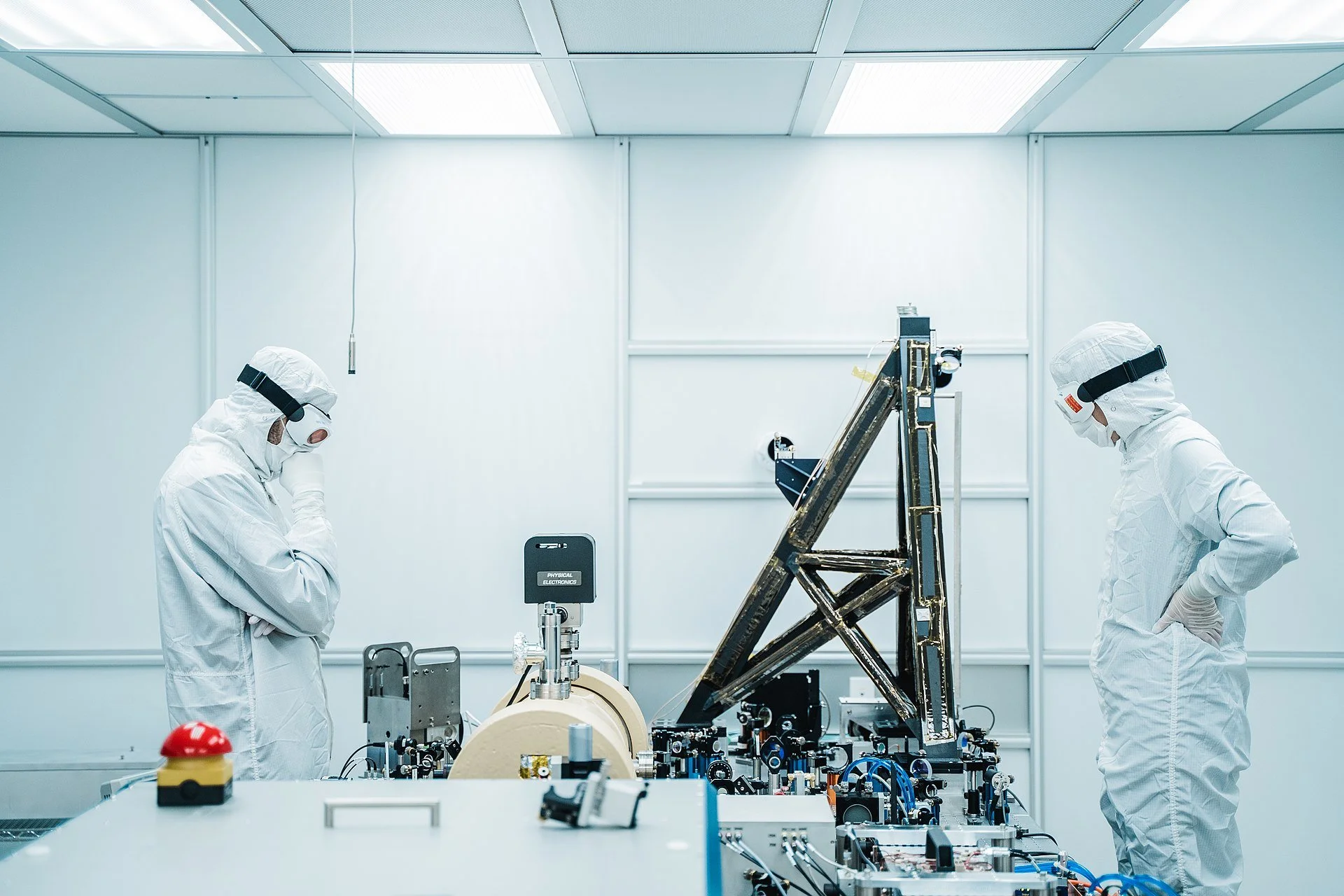
Two scientists inside LIGO Pre-Stabilized Laser enclosure. By Nutsinee Kijbunchoo, CC-BY-4.0, Wikimedia Commons
Practice-based research, especially in artistic contexts, is a field of inquiry that gets its nourishment from both theory and practice. How does these two different approaches to learning, thinking, making, doing, living take place not only in the academy, but in everyday life as well?
The first area of inquiry of our project is Discovery from Making. Our official description reads:
Although creators already know that insights are achieved through the process of creation – and will have their own frameworks for this – research-creation scholars have established techniques and principles that can scaffold creative discovery in dependable ways, as well as theoretical foundations that can ground the personal qualities of individual creativity in a broader and more structured context.
Here, we imply that these creative insights are achieved through different processes of making, whether they are artistic, tacit, or explicit. We also interpret research-creation as a systematic approach to creative discoveries, as it is usually embedded in an academic context. These ideas that are part of the practice-based methodologies—trial and error, experimentation, continuity, modularity (as in repeating a certain practice over and over again, but slightly differently each time)—sometime overlap with the stereotype of the scientist as someone who does a series of trials and errors in a controlled lab before reaching a publishable conclusion.
But questions arise when creative practice meets academia, and these methodologies are applied to artistic, social, and personal contexts. We see many discussions that question whether a degree—an MFA, a PhD —is essential to deepening one’s work, or if it risks constraining it (especially given the discourse of the “crisis of the Humanities” that we are well used to navigating). Many artists describe a sense of dissonance and disillusionment within academic contexts, where they feel constrained when their creativity must be translated into theoretical language to be recognized as legitimate. (Surprisingly, or not, I have heard similar frustrations from early-career scientists).
Yet for other artists, these tensions become productive, and they are able to work with them and emerge from their studies with a stronger practice. In Living a Feminist Life, Sarah Ahmed speaks on how to look at theory:
Theory itself is often assumed to be abstract: something is more theoretical the more abstract it is, the more it is abstracted from everyday life. To abstract is to drag away, detach, pull away, or divert. We might then have to drag theory back, to bring theory back to life.
Throughout her work, Ahmed uses an approach embedded in feminist and queer phenomenology—or, in short, a theory that is deeply embedded in the lived experiences of non-normative bodies. Instead of constraining, theory for Ahmed is alive, personal, political, and deeply connected to the everyday. Moving forward, as we look into our other research areas, we will analyze how other authors apply these concepts to their daily lives and practices in even more embedded ways.

